



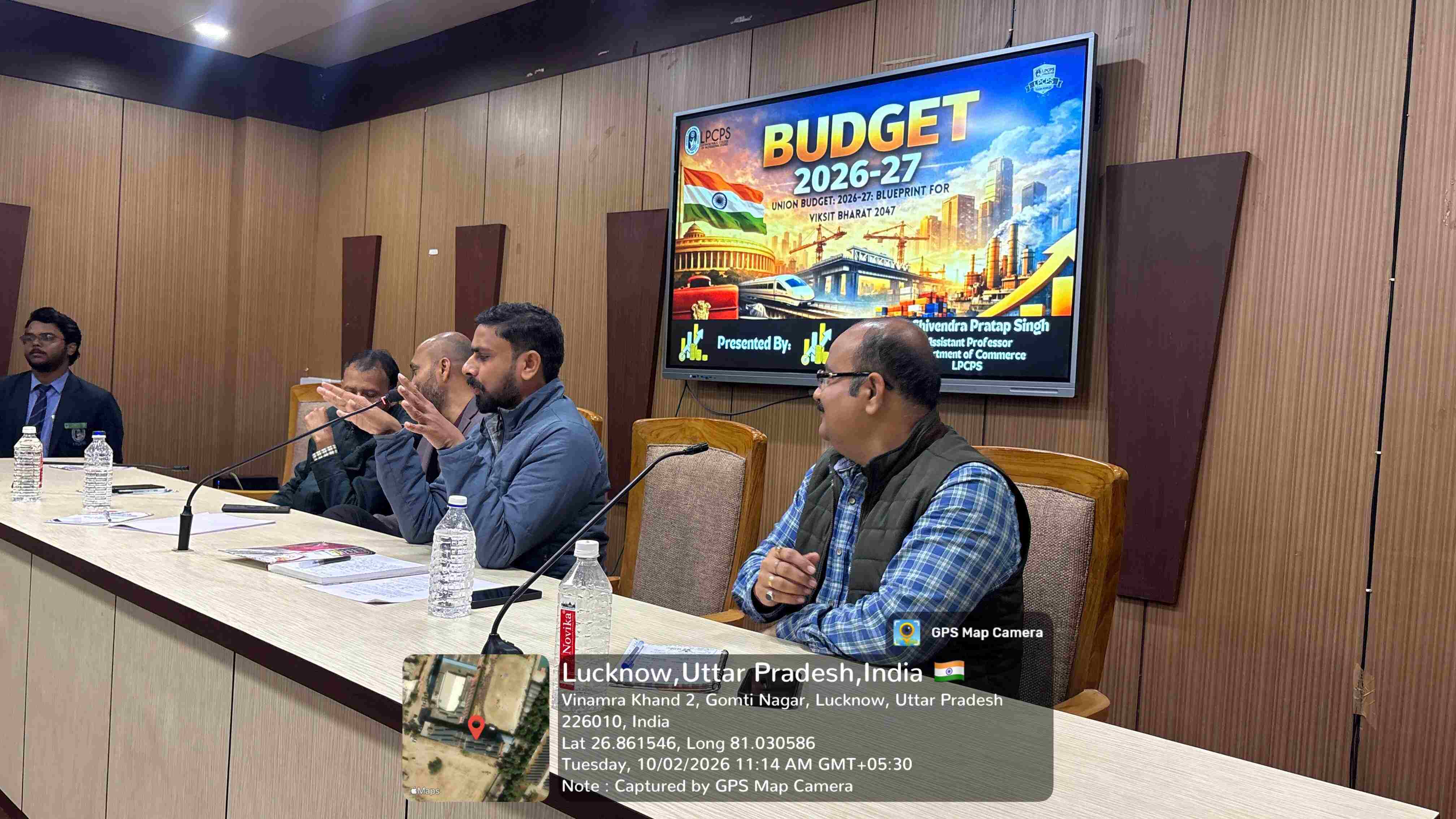
As a part of its professional extension activities, the Lucknow Public College of Professional Studies (LPCPS) organized an insightful technical session focused on the Union Budget 2026-27. The event aimed to decode the complexities of the national budget for students, particularly those in the fields of Commerce and Journalism, to help them understand how fiscal policies shape the Indian economy.
Session Highlights
1. Economic Analysis and Infrastructure
Mr. Shivendra Pratap Singh (Assistant Professor & Proctor) opened the session by outlining the core financial framework of the 2026 Budget. He highlighted the significant increase in public capital expenditure, which rose to ₹12.2 lakh crore.
- Key Discussion: The development of seven high-speed rail corridors as "Growth Connectors."
- Taxation: He explained the transition toward the New Income Tax Act, 2025, which came into effect this April, focusing on simplified rules and redesigned forms for easier compliance.
2. Social Impact and Institutional Reforms
Dr. Daya Shankar focused on the socio-economic dimensions of the budget, emphasizing the "Three Kartavyas" (Duties) that guided this year's proposals.
- MSME Support: He detailed the ₹10,000 crore SME Growth Fund designed to turn promising MSMEs into "Champion SMEs."
- Education & Skilling: Discussion on the establishment of AVGC (Animation, Visual Effects, Gaming, and Comics) Content Creator Labs in 500 colleges across India to boost Yuva Shakti.
3. Media Perspective and Public Communication
Dr. Neeraj Singh (Head, Dept. of Journalism and Mass Communication) provided a unique perspective on the role of media in interpreting the budget.
- Critical Analysis: He taught students how to look beyond the numbers to understand the "narrative" of the budget.
- Fact-Based Journalism: He stressed the importance of responsible reporting to ensure that the public understands the long-term impacts of fiscal deficits (targeted at 4.3% of GDP for 2026-27) and new tax holidays for data centers.
The session concluded with a vibrant Q&A segment where students engaged with the experts on various topics. The college also thanks all the participants for their active involvement. The session was well-organized and successfully achieved its objective of educating students on the government budget. The college plans to organize more such informative sessions in the future.
अपने व्यावसायिक विस्तार कार्यक्रमों के अंतर्गत, लखनऊ पब्लिक कॉलेज ऑफ प्रोफेशनल स्टडीज (एलपीसीपीएस) ने केंद्रीय बजट 2026-27 पर केंद्रित एक ज्ञानवर्धक तकनीकी सत्र का आयोजन किया। इस कार्यक्रम का उद्देश्य छात्रों, विशेष रूप से वाणिज्य और पत्रकारिता के क्षेत्र में अध्ययनरत छात्रों को राष्ट्रीय बजट की जटिलताओं को सरल भाषा में समझाना था, ताकि वे यह समझ सकें कि राजकोषीय नीतियां भारतीय अर्थव्यवस्था को कैसे प्रभावित करती हैं।
सत्र की मुख्य बातें
1. आर्थिक विश्लेषण और अवसंरचना
श्री शिवेंद्र प्रताप सिंह (सहायक प्रोफेसर एवं प्रोक्टर) ने 2026 के बजट के मूल वित्तीय ढांचे की रूपरेखा प्रस्तुत करते हुए सत्र का शुभारंभ किया। उन्होंने सार्वजनिक पूंजीगत व्यय में हुई महत्वपूर्ण वृद्धि पर प्रकाश डाला, जो बढ़कर ₹12.2 लाख करोड़ हो गया।
• मुख्य चर्चा: सात हाई-स्पीड रेल कॉरिडोर का विकास "विकास कनेक्टर" के रूप में।
• कराधान: उन्होंने अप्रैल में लागू हुए नए आयकर अधिनियम, 2025 की ओर संक्रमण की व्याख्या की, जिसमें सरलीकृत नियमों और अनुपालन में आसानी के लिए पुनर्रचित प्रपत्रों पर जोर दिया गया।
2. सामाजिक प्रभाव और संस्थागत सुधार
डॉ. दया शंकर ने बजट के सामाजिक-आर्थिक आयामों पर ध्यान केंद्रित किया और इस वर्ष के प्रस्तावों को निर्देशित करने वाले "तीन कर्तव्य" (कर्तव्यों) पर जोर दिया।
• MSME सहायता: उन्होंने ₹10,000 करोड़ के SME विकास कोष का विस्तृत विवरण दिया, जिसे होनहार MSME को "चैंपियन SME" में बदलने के लिए डिज़ाइन किया गया है।
• शिक्षा और कौशल विकास: युवा शक्ति को बढ़ावा देने के लिए भारत भर के 500 कॉलेजों में AVGC (एनिमेशन, विजुअल इफेक्ट्स, गेमिंग और कॉमिक्स) कंटेंट क्रिएटर लैब की स्थापना पर चर्चा की गई।
3. मीडिया परिप्रेक्ष्य और जनसंचार
डॉ. नीरज सिंह (पत्रकारिता और जनसंचार विभाग के प्रमुख) ने बजट की व्याख्या में मीडिया की भूमिका पर एक अनूठा दृष्टिकोण प्रस्तुत किया।
• आलोचनात्मक विश्लेषण: उन्होंने छात्रों को बजट के "स्वरूप" को समझने के लिए आंकड़ों से परे देखने का तरीका सिखाया।
• तथ्य-आधारित पत्रकारिता: उन्होंने राजकोषीय घाटे (2026-27 के लिए जीडीपी के 4.3% का लक्ष्य) और डेटा केंद्रों के लिए नई कर छूटों के दीर्घकालिक प्रभावों को जनता तक पहुंचाने के लिए जिम्मेदार रिपोर्टिंग के महत्व पर जोर दिया।
सत्र का समापन एक जीवंत प्रश्नोत्तर सत्र के साथ हुआ, जिसमें छात्रों ने विभिन्न विषयों पर विशेषज्ञों के साथ विचार-विमर्श किया। कॉलेज सभी प्रतिभागियों को उनकी सक्रिय भागीदारी के लिए धन्यवाद देता है। सत्र सुव्यवस्थित था और सरकारी बजट पर छात्रों को शिक्षित करने के अपने उद्देश्य को सफलतापूर्वक प्राप्त किया। कॉलेज भविष्य में इस तरह के और अधिक जानकारीपूर्ण सत्र आयोजित करने की योजना बना रहा है।